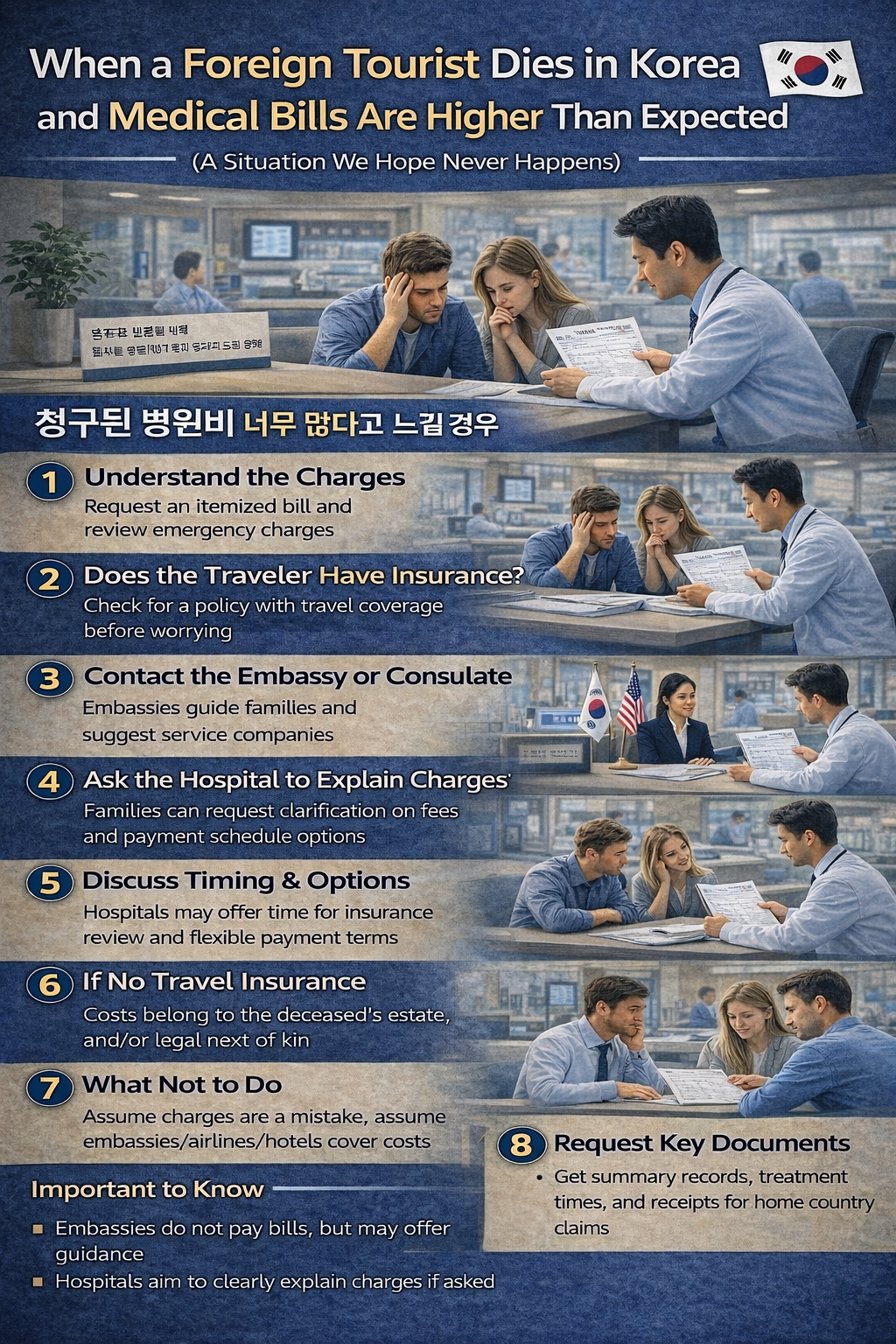
A Practical, Neutral Guide (A Situation We Hope Never Happens)
Korea welcomes millions of visitors every year.
Most leave with good memories—food, culture, festivals, and friendly hospitality.
But in extremely rare cases, a traveler may pass away unexpectedly
due to illness, medical complications, or emergency events.
And sometimes, the medical bills that follow
may appear higher than the family expected.
This guide explains, in a neutral and informational manner,
what generally happens when medical costs rise after a foreign traveler’s death in Korea,
and what contact points exist for support.
This article does NOT provide legal or financial advice.
It summarizes public information and general procedures
based on how Korea typically handles such cases.
■ Why Medical Costs May Be Higher Than Expected
When an emergency occurs—especially if the person is
unconscious, alone, or critical—medical responders and hospitals
often do everything they can to save the patient.
Because of this:
- Ambulance transport may occur
- Emergency treatment may begin immediately
- ICU admission may be needed
- Tests and imaging (CT, ultrasound, blood panels) may be required
- Specialized staff may be involved
Medical teams make urgent decisions
without waiting for insurance approval or family consent
because preserving life is the priority.
This is true whether the patient is Korean or foreign.
■ 1. Confirming What the Charges Represent
When hospital bills seem large,
the first step is simply understanding what they include.
Typically, charges may reflect:
- Emergency room evaluation
- Medical supplies
- Diagnostic tests
- ICU or room usage
- Professional services
- Medication
- Life-saving treatment attempts
- Pronouncement and records
- Facility fees
Hospitals generally provide a detailed itemized bill on request.
Many families find clarity once each item is explained.
■ 2. Who Pays if Insurance Is Not Present?
Unlike some countries,
Korea does not automatically assign medical discounts
to uninsured short-term visitors.
Bills usually become the responsibility of:
- The individual (estate), and/or
- Their legal next of kin
This is standard practice internationally.
However, how families choose to resolve the bill
depends on their home country’s rules, estate systems, and insurance agreements.
■ 3. If the Traveler Had Travel Insurance
This is often the biggest turning point.
Many travel insurance plans—if purchased before the trip—may cover:
- Emergency medical care
- Hospitalization
- Diagnostic tests
- Transport
- Repatriation
- Sometimes outstanding medical invoices
Coverage varies widely.
Families should:
- Locate policy details,
- Contact the insurance provider,
- Request case handling directly through the insurer.
In many cases, insurers communicate with hospitals themselves.
■ 4. Contacting the Embassy or Consulate
If the bill feels overwhelming,
the traveler’s embassy or consulate becomes an essential partner.
Embassies cannot erase the bill or pay it,
but they often:
- Help families understand the documents,
- Provide translation support,
- Suggest reputable service companies,
- Explain how similar cases are typically resolved,
- Confirm whether additional international options exist.
This can remove much of the confusion during an emotional time.
■ 5. Hospitals and Billing Offices Can Explain Charges
Most Korean hospitals have:
- International service desks,
- Multilingual staff,
- Billing departments familiar with overseas cases.
Families can ask for:
- Explanation of fees
- Written itemization
- Receipt clarifications
- Hospital’s policy on payment schedule or timeline
- Available communication channels for insurers
It’s common for hospitals to respond professionally and patiently.
■ 6. Payment Timing and Discussion Opportunities
In many countries, medical debts must be handled immediately.
In Korea, hospitals may:
- Allow delayed payment (case by case)
- Communicate with insurance directly
- Provide documents required for travel or estate processing
- Offer guidance for handling the balance from abroad
The hospital decides how flexible it can be—
but families should not hesitate to ask questions.
■ 7. What Families Should Avoid
To protect themselves emotionally and administratively,
families should avoid:
✘ Relying solely on hearsay or online advice
✘ Assuming the hospital made a mistake without verification
✘ Ignoring bills or communication
✘ Assuming embassies or airlines will take responsibility
✘ Making payments before insurance responds, if applicable
Taking time to gather facts is the safest first step.
■ 8. What Families Can Request (Information Only)
Families commonly request:
- Medical summary
- Certification that treatment occurred
- Time of admission and discharge records
- List of tests performed
- Cause-of-death documentation (if applicable)
- English-language copies when available
These can later be used for:
- Claims in the home country,
- Reimbursement requests,
- Legal administration.
■ Emotional Realities Behind These Procedures
Even though procedures appear administrative,
they take place during a time of shock and grief.
Korean medical staff, support personnel,
and embassies generally handle these cases
with professionalism and respect.
Many families share that
clear explanations about charges
helped them feel more in control
during an incredibly painful situation.
'여행정보팁(Travel)' 카테고리의 다른 글
| 2026 : “출국 전 이 3가지만 준비하면 끝 — 전자여권·eSIM·보험 완벽 정리” (0) | 2026.01.12 |
|---|---|
| 2026 : 항공사마다 다른 수하물 규정, 이거 모르면 손해 (0) | 2026.01.12 |
| 외국인 여행자가 한국에서 사망했을 때: 단계별 절차 안내 (0) | 2026.01.11 |
| ENG : Healthcare Benefits for Foreigners Living in Korea (0) | 2026.01.10 |
| Step-by-Step Guide: How Foreigners Visit a Clinic in Korea (0) | 2026.01.09 |


