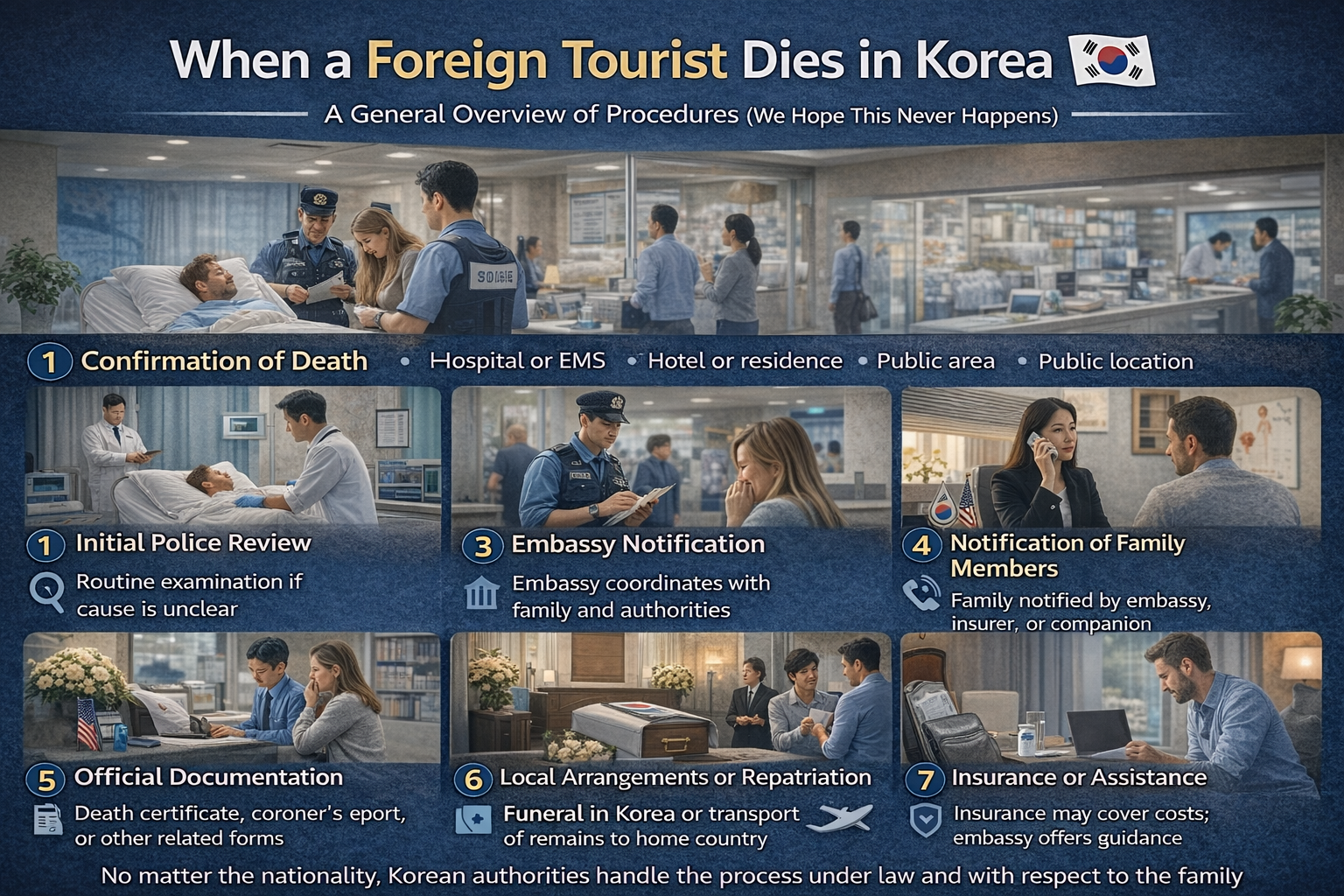
A Practical Overview of the Procedures (A Situation We Hope Never Happens)
Millions of travelers visit Korea every year
to enjoy food, culture, history, and modern city life.
Most trips end happily.
But in extremely rare cases, a foreign visitor may pass away
during their stay due to illness, accident, or sudden medical issue.
It is not a topic anyone wants to think about,
but knowing what happens next can bring clarity
to family members, travel companions, and support organizations.
This guide summarizes, in neutral and factual terms,
the general process that may occur when a foreign tourist dies in Korea.
Procedures can vary by cause, location, nationality, and legal requirements.
The purpose of this article is to provide general awareness,
not legal, medical, or insurance advice.
■ 1. Confirmation of Death
A death may occur:
- At a hospital,
- During emergency transport,
- At a hotel or residence,
- Outdoors or in public areas.
The first official step is confirmation by a medical professional or emergency responders.
Typical pathways:
① Death in a medical setting
- Doctors confirm death
- Records are made in hospital systems
② Death outside a hospital
- Emergency personnel (119) and police are dispatched
- The body is transported for medical confirmation
③ Suspicious or unclear causes
- Investigation may begin to determine circumstances
Regardless of nationality,
this is handled under Korean law and safety protocol.
■ 2. Initial Police or Agency Review
If the death is unexpected
or the cause is unclear,
police may conduct a routine examination.
This may involve:
- Reviewing the scene
- Speaking with witnesses
- Collecting documentation
- Confirming identity
Foreigners are not treated differently from Korean citizens.
The purpose is to ensure the situation is properly recorded.
■ 3. Notification of Embassy or Consulate
When a foreign national dies in Korea,
their country’s embassy or consulate becomes involved.
Contact may be initiated by:
- Police or hospital officials,
- Travel companions,
- Insurance companies,
- Family members abroad.
Diplomatic staff typically provide:
- Guidance for the family
- Translation or communication support
- Contact coordination
- Document instructions
However, embassies do not take custody of remains or pay costs.
They assist in communication and navigation.
■ 4. Notification of Family Members
Once identity is confirmed,
the family is informed through:
- Embassy contact,
- Travel partner communication,
- Insurance support, if applicable.
Because time zones and privacy laws vary,
this step may take coordination across multiple organizations.
■ 5. Official Documentation
Depending on the situation, relevant documentation may include:
- Death certificate (hospital death)
- Medical examiner or coroner report (non-hospital death)
- Additional forms if required by authorities
These documents are important for:
- Insurance claims,
- Repatriation,
- Funeral decisions,
- Legal closure in the home country.
Embassies often advise families
on how to obtain or translate documents if necessary.
■ 6. Choosing Between Local Arrangements or Repatriation
Families generally choose one of two paths.
① Local arrangements in Korea
Families may request:
- Funeral ceremonies,
- Cremation,
- Burial (limited and usually based on religion or family instruction)
Korea has professional facilities and funeral homes
that can assist international clients.
② Repatriation to home country
A more common choice for short-term travelers.
This involves:
- Preparation of remains for transport
- Required paperwork
- Airline compliance
- Coordination between funeral service providers in Korea and abroad
This process is often handled through:
- Specialized service companies,
- Insurance contacts (if applicable),
- Embassy guidance.
■ 7. Travel Insurance or Assistance Providers
If the traveler purchased international travel insurance,
a portion of the later procedures may be supported.
Insurance plans differ greatly,
but may include:
- Repatriation assistance,
- Paperwork support,
- Coordination with funeral homes.
Without insurance,
families typically work directly with embassy-recommended partners.
■ 8. Personal Belongings and Closure Steps
Final administrative steps may involve:
- Retrieval of personal belongings from hotels or residences
- Canceling accommodations or itineraries
- Collecting passport and travel documents
- Closing travel or visa records
A trusted companion or official representative
usually handles these matters with embassy assistance.
■ Humanity Behind the Process
Even though procedures are administrative,
Korean authorities, hospital staff, and diplomatic collaborators
generally handle such events with respect.
Many family members have shared that
support and guidance from Korean institutions
helped them manage an unimaginable situation
during a painful moment.
'여행정보팁(Travel)' 카테고리의 다른 글
| 외국인이 한국 여행 중 받을 수 있는 정부 및 공공 혜택 총정리 (0) | 2026.01.08 |
|---|---|
| 외국인 여행자가 한국에서 사망했을 때 병원비가 과다 청구된 경우 (0) | 2026.01.08 |
| KOR : 외국인이 한국에서 받을 수 있는 의료 혜택 총정리 (0) | 2026.01.08 |
| 한국에 온 외국인이 꼭 먹어봐야 할 메뉴는? (1) | 2026.01.08 |
| 외국인과 함께 가면 “한국이 이런 곳이었어?”라는 말이 나오는 서울 근교 여행지 5곳 (1) | 2026.01.02 |


